Search This Blog

Monday, March 26, 2012

Siamese Army (16-17th centuries)

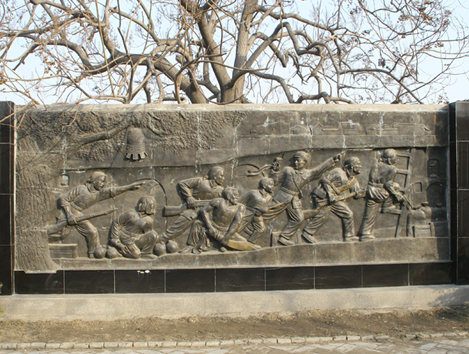
King Naresuan monument, Thailand

I have begun bulding a 1/72 Ayutthaya (Siamese) army for the wars with Burma (Tounghoo Dynasty) in the 16th to 17th century. Naturally this means converting existing lines and finding easy ones to do at that since I will need to make lots.

Below are my first jabs at making basic infantry. Most of the originals (in dark tan plastic) come from the 1/72 HäT Miniatures set of Sea Peoples; the only exception (in blue plastic) is from the Caesar Miniatures Sea Peoples set. HäT's Sea Peoples are not the best sculpts to begin with but are rather versatile and easy to convert. But they are also bigger and taller than the Caesar figures, which have the advantage of finer details and proportions, so I will have to deploy the converted minis in their separate respective units.

I added some leather helmets (see next post for how I made them) and will rely on painting to achieve the rest of the desired results.


Tunnel Warfare Diorama


This is a diorama at the Beijing Military Museum that depicts "tunnel warfare" (地道戰) in the Second Sino-Japanese war. It shows a Japanese patrol attempting to control a Chinese village and partisans falling back on a carefully laid-out system of tunnels and rooftop passages to defend and snipe at the enemy. It includes an interesting vignette that shows Japanese chemical troops poisoning a well. I cannot be certain about the scale as I took these pictures two years ago but I believe it to be 1:35 or slightly larger.


A Hazmat team at work? An interesting depiction of the use of chemical warfare at the small, local level.


 A life-size representation of the partisans.


Tunnel warfare was a well-known feature of partisan tactics during the second Sino-Japanese war. As a form of armed "peasant resistance" against foreign aggression, it also conformed well to the political ideology of the CCP, which after 1949 did much to glorify it through the commissioning of monumental art, films and even the building of "tunnel museums" wholly devoted to its commemoration.


There is a 1966 PLA "propaganda film" about this facet of the war that is well worth finding and watching. I have the DVD but also found it online. The entire black-and-white film is being hosted here:
http://www.tudou.com/programs/view/Jw0GIwoAsXk/

If you just want to hear the rousing patriotic song: 

There is a more recent remake of "tunnel war" in the form of a 2010 TV series in 40 episodes!  I believe this version follows a soap-operatic format so may be too much to bear for the majority of us who are mainly interested in the military and modeling aspects. The full series is available on this Chinese site: 

You can also try YouTube, as the first part is there at least: 

20mm Monte Cassino Ruins

Between Jan and mid-May, 1944, German forces and Allied armies that included Americans, British, Poles, and the Free French fought several desperate battles along the German "Gustav Line." In the process, the famous monastery established by St. Benedict on Monte Cassino and the town of Cassino below were completely destroyed. Cassino itself became a byword for wanton destruction.

Cassino Town Ruins


One-piece resin foam casting of Cassino town ruin from Monday Knights Productions (they call it Village Ruins), which is reissuing terrain models that used to be produced by Scenic Effects. Footprint 15" x 23". The third picture below shows two of these terrain pieces set side by side.


Monte Cassino Monastery Ruins


One-piece resin foam casting of Monte Cassino Monastery ruin from Monday Knights Productions (they call it Town Ruins). Footprint 15" x 23". In both size and physical configuration, the terrain piece fails to represent the actual Monte Cassino monastery in my view. But as a representative "ruin" it looks rather nice once painted up.

I couldn't resist making some modifications to the façades to give them more definition. The "real colour" is a bit warmer than it appears in these photos and somewhat matches that of the Cassino town ruins shown above.